xxxx

Friday, March 27, 2026

The Often Overlooked Role of Women in War

Most accounts of war focus on men and military battles. Women are overlooked. Yet during the Civil War (1861–1865), women on the home front took on unprecedented roles, managing farms, running businesses, and working in factories to sustain the economy and war effort. They formed aid societies, nursed wounded soldiers, and acted as spies, while some disguised themselves as men to fight.


                                        Richmond, Virginia Food Riot

A quickly emerging issue in war is food shortages. In the South, the breakdown of railroad transportation, blockades, high inflationary food prices all led to possible starvation. Confederate women found food substitutes replacing wheat flour with rice which was plentiful in the South, substituted bacon grease for butter, sorghum for sweetener, and coffee was made from chicory..


Southerners had a few advantages which helped ensure their survival:

1. Yankees often overlooked the patches of sweet potatoes, thinking they were weeds.

2. Southerners knew their local terrain better than did the Yankees. They knew its hiding places, and hid livestock such as pigs, in swamps and forests, and gold and silver in wells.

A common image of the Southern woman is the plantation mistress. An image of the lady of leisure hosting elaborate dinners and parties comes to mind, her main labor simply directing the duties of her house slaves.

The war changed everything. Women tried to manage large plantations, overwhelmed and frightened. Simply managing overseers challenged them. In the final days slaves ran off, some husbands never returned, it’s difficult to imagine their plight.

And yet they endured, adapted, fed their children. War is more than firing bullets or throwing and dropping bombs. It’s a populace faced with insurmountable challenges, often left in the responsibility of women.

Thursday, February 5, 2026

Civil War era ~ Oatmeal Pie frugal recipe

Food prices are crazy! But we can only imagine how Civil War women coped with high inflation and food shortages. The Confederate states experienced extreme, runaway inflation during the Civil War, with prices rising over 9,000% from 1861 to April 1865. By the end of the war, the Confederate dollar was nearly worthless due to massive printing of currency, supply shortages, and the Union blockade.

A thrify dessert is Oatmeal Pie. Oatmeal pie was also known as “poor man’s pecan pie” or “mock pecan pie." During tough economic times people can't afford pecans. The following recipe provides flavors that substitute for pecans, which were hard to find. A very frugal recipe and tasty.

Old Fashioned Oatmeal Pie

Ingredients:

1 (9 inch) pie crust
4 eggs
1 cup sugar
2 tablespoons flour
1 teaspoon ground cinnamon
1/4 teaspoon salt
1 cup light corn syrup (sorghum or molasses during Civil War)
I add molasses, it’s full of vitamins
1/8 to 1/4 cup melted butter
1 teaspoon vanilla
1 cup quick cooking oatmeal (uncooked)

Directions:
Preheat oven 350 degrees. Beat eggs until frothy. Combine sugar, flour, cinnamon, and salt in small bowl. Add eggs and mix well. Add corn syrup, melted butter and vanilla. Mix oatmeal. Pour into uncooked pie shell. Bake for 45 minutes.

It was very popular was during the Great Depression when everything was in short supply. We still want our sweets! Oatmeal pie is made with basic ingredients that were and still are in most of our pantries.


Tuesday, February 3, 2026

Civil War Food: Soldiers and Civilians

As the Civil War continued, food became scarce.   High inflation in the Confederacy made staples unaffordable for many. Soldiers and civilians were forced to forage the countryside to supplement their meager diets.

The Soldier's Food


Yankee Soldier:  Hardtack


Hard as a rock, this cracker was the bane of many a Civil War soldier.  The ingredients were simple: wheat flour, water, and maybe some salt, mixed into a dense dough, rolled and cut into biscuit sized squares.  Hardtack was almost inedible and nearly dense enough to stop a musket ball.  To soften, hardtack was often dunked in brine, coffee, or cooked with salt pork.  
The recipe:

Ingredients:
2 cups of flour
 1/2 to 3/4 cup water 
6 pinches of salt
Optional:  add 1 tbsp of vegetable fat 

Preheat oven to 400 degrees F.  Mix the ingredients together into a stiff dough, knead several times, and spread the dough out flat to a thickness of 1/4 inch on a non-greased cookie sheet.  Using a knife, cut dough into 3-inch cracker squares.  Punch four rows of holes, four holes per row, into each cracker.

Bake for 30 minutes. Remove from oven, turn crackers over on the sheet and return to the oven and bake another 30 minutes. Cool completely.


Confederate Soldier
Sloosh

Many Southern soldiers simply cooked cornmeal mush around a rifle ramrod and cooked it over the campfire. That was called "sloosh". 

Corn Pone
Corn pone was a staple of early settlers and Civil War soldiers.


Recipe

4 cups ground white or yellow cornmeal 
1 tablespoon salt 
2-3 cups of very hot (not boiling) water 
 1/4--1/2 cup bacon grease or other oil


In a large bowl, add the hot water to the corn meal and mix into a thick batter. Cover with a dishcloth and let it sit for 15 to 20 minutes. The batter should still be soft enough to mold into a small cake.  Cook medium heat on the stove or over your fire, add the bacon grease or oil. When the oil is hot lay the cakes into the pan. Cook them until they are browned on one side, this should take about 3 minutes. Turn each and brown on the other side. Drain the fat and serve.


Food on the Home front 
Lacking many ingredients, the southern women learned to alter food recipes according to their scarce available resources.  


The south still had rice and black eyed peas.  Hoppin' John was popular and nutritious.


Oatmeal pie recipe:


The military needed a cheap way to feed a lot of people, and soldiers across the country were introduced to the idea they could eat their horses' oats.  So oats become a popular food for soldiers and civilians.   


Idiot's Delight cake recipe:


An easy dessert to make, "Idiot's Delight" cake was quick and frugal.  It was often served on Christmas and Holidays.


Saturday, January 3, 2026

Civil War Confederate Christmas Celebrations

CHRISTMAS ON THE HOMEFRONT

For women on the home front, Christmas during the Civil War was a subdued and often difficult day. For children, presents were fewer, especially in the devastated South.  

Kate Stone (1863) Louisiana native Christmas Night [1863]
 "The day has passed most quietly, not a cake, not a visitor. We did have an eggnog but only the servants enjoyed it. ..dear little Beverly raised up in bed, and looking at her stockings saw only some homemade toys, bedstead and chairs made of white pine by the plantation carpenter, hid her head, sobbing that she 'would not have the ugly common fings.' Aunt Laura told her how bad that was and that poor Santa Claus had done his best but he could not get through Yankee lines."

Lucy Virginia French, in Virginia:
"We had to be “Santa Claus” ourselves this season, for cakes, apples, a little candy, & some picture books were all that could be procured for the children. We had to tell them Santa Claus couldn’t get thro’ the pickets."

CHRISTMAS ON THE BATTLEFIELDS

Soldiers celebrated Christmas with makeshift trees decorated with hardtack pork and biscuits, with dried fruit and popcorn. They sang familiar hymns and carols like "Silent Night," and "Hark, the Herald Angels Sing" to boost morale.  

While some experienced meager meals of coffee and hardtack, others received packages from home with brandy, sugar for eggnog, or other small luxuries.

painting by Mort Kunstler

Wednesday, May 21, 2025

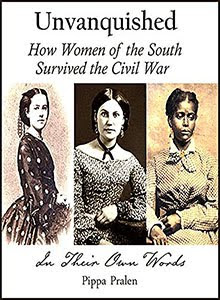
Book: Unvanquished: How Confederate Women Survived the Civil War


Brave southern women tell how they survived the desperate last days of the Confederacy in eyewitness accounts.  They outwitted the plundering Yankees and fed starving children. Includes accounts of slave women. 

Civil War food recipes:  cabbage stew, hoppin' John, oatmeal pie, Johnny cakes, molasses cookies etc.  Amazon Best Seller.
  
Click here:


Monday, May 12, 2025

Civil War: Starvation Descends Upon the South

Starvation loomed as a stark possibility for many Southern women. Desperate women, trying to feed hungry children resorted to robbery.  

"To be hungry is there an everyday occurrence. For ten days, ...lived off just hominy enough to keep their bodies and souls from parting, without being able to procure another article; not even a potato... I am satisfied that two months more of danger, difficulties, perplexities, and starvation will lay her (Mother) in her grave. "~ Sarah Morgan, Louisiana


Food Riots
The women knew food was stored in depots and warehouses.  In cities from Alabama, to Virginia, gatherings often erupted into riots in which crowds of women, broke into stores, depots, and warehouses and carried off supplies.

In the town of Salisbury, North Carolina in March 1863, a group of 75 women armed with axes and hatchets descended upon the railroad depot and local stores, desperate for food.  The women thought that the railroad agent and the store owners were hoarding flour, to sell later at a higher price.  When faced with the angry mob, the storekeepers reluctantly gave flour, molasses, and salt to the women.

Richmond, Virginia - Bread Riot

In April 1863, a “mob of women” desperate with hunger, marched up Main Street, entered the stores of the suspected speculators and emptied them of their contents.  


Eventually Jefferson Davis appeared, spoke to the crowd, and calmed the women who left, reluctantly, with their stolen baked goods.


Yankee marauders made the situation worse. Luckily, two factors saved the Confederate families:

1) the local southerners knew the land and hid food and livestock

2) Yankees thought sweet potatoes were weeds and overlooked them when they plundered.


Friday, April 19, 2024

Civil War: Buried Treasure

Ex Slave Finds Buried Treasure

Many plantation owners buried their jewels, silver, and gold coins to keep it out of the hands of Yankee marauders. A lot of these men never told their wives of its location, afraid that under pressure it would be revealed. Some of these Confederate soldiers died in battle, never to return to unearth it. It still lies underground not yet found.

Sharecroppers Find Buried Wealth:
Martha Richardson had been a slave girl in Columbia, South Carolina. Martha and her brothers were working in the fields one day as sharecroppers. As they chopped, her older brother’s shovel hit something hard. He dug more and saw it was the lid of a pot.


They removed the lid and saw it was filled with silver and gold coins. They quickly return to their family cabin to show the pot to their Mother.  She first tells the children to watch the door and see that no one enters.  She counts the coins slowly and tells them the money amounts to $5,700.  ($5,700 is equivalent to $95,000 in today’s money). She asks them to swear to tell no one about their find.

With the newly found wealth, Martha’s Mother bought 2 lots of land.  They continued to present a humble appearance and work as sharecroppers, but they also built a house for the family and a cottage they rented out.  Martha was eternally grateful for this money which allowed her family to escape from debt and to find some relief from their hard toil.  Their lives were completely changed.  

Source:  Federal Writers' Project: Slave Narrative Project, Vol. 14, South Carolina, Part 4, Raines-Young

Click below to read more:


Monday, January 16, 2023

Returning Defeated Soldiers

Mary Ann Harris Gay describes the family reunion with her returning Confederate soldier brother:

"As we stood upon the platform of the Decatur depot, and saw him step from the train ... our hearts were filled with consternation and pity, and tears unbidden coursed down our cheeks, as we looked upon the brave and gallant brother, who had now given three years of his early manhood to a cause rendered dear by inheritance and the highest principles of patriotism, and, in doing so, had himself become a physical wreck. 

He was lean to emaciation, and in his pale face was not a suggestion of the ruddy color he had carried away. A constant cough, which he tried in vain to repress, betrayed the deep inroads which prison life had made upon his system."

These young, handsome boys that had gone to war came back changed.9

READ MORE about women and the Civil War, read eyewitness accounts.  Available on Amazon.com Kindle ebooks.  Click below:


Monday, March 23, 2020

Epidemics, Pandemics, Infectious Diseases of the American Civil War

The deadliest thing that faced the Civil War were infectious diseases. For every soldier who died in battle, two died of disease.   During the 1860's, doctors had yet to develop bacteriology and were generally ignorant of the causes of disease. Generally, Civil War doctors underwent two years of medical school, though some pursued more education.  Some 10,000 surgeons served in the Union army and about 4,000 served in the Confederate.


Surgeons of the Civil War

In the years before the war, training for physicians in the United States was mostly unregulated, and medical schools' access to cadavers for teaching purposes was highly restricted. In spite of these limitations, many army physicians rose to the challenges of the war, undertaking new methods of study and experimentation.


"Government inaction or delay have shaped the course of many infectious disease outbreaks in our country, including the American Civil War.  

There were smallpox epidemics among civilians, although a vaccine existed.  Smallpox exploded at this time not because of a lack of protocols or knowledge—a vaccine even existed—but because political leaders simply didn’t care about the group that was getting sick. Government inaction or delay—due to racial discrimination, homophobia, stigma, and apathy—have shaped the course of many epidemics in our country. (Jim Downs, The Epidemics America Got WrongThe Atlantic Magazine, Mar 22, 2020)

When the first cases of smallpox broke out among troops during the Civil War, military officials—on the Union and Confederate sides alike—immediately quarantined the infected in a tent or a makeshift hospital to prevent the transmission of the virus. But when smallpox began spreading among formerly enslaved people, officials either ignored it or argued that the virus spread viciously among black people because of racial inferiority and unsanitary habits.

In the months after President Lincoln had issued the Emancipation Proclamation in January of 1863, no infrastructure was in place to provide new freed people with basic necessities, let alone to combat a deadly virus. Mortality rates increased. In the face of a widespread epidemic, the people had to help themselves in order to survive. Harriet Jacobs, a formerly enslaved woman who had escaped to the North but returned to the South to help, wrote to charitable groups and asked them to immediately send clothing, blankets, and other resources. With the money Northern benevolent associations sent, Jacobs, with the eventual assistance of the military, constructed a makeshift hospital for freedpeople.


READ MORE about women and the Civil War.  Eyewitness accounts:


Wednesday, October 16, 2019

Slaves Find a Pot of Gold - Civil War Stories


A Pot of Gold
During the Civil War, many a Southern family buried their jewels, silver and gold coins in the ground, to hide from Yankee plundering.  Many Confederate men died in battle, never to return to unearth it. They often hid the location even from their wives, so the site would not be revealed under pressure.

Martha Richardson had been a slave girl in Columbia, South Carolina.   

Martha and her brothers were sharecroppers, working in the fields.  

As they chopped, her older brother’s shovel hit something hard.  He dug more and saw it was the lid of a pot.  Martha describes what happened:

“It was no sooner out than we takes off de lid and we is sho’ surprised at what we see. Big silver dollars lay all over de top.  

We takes two of them and drops them together and they ring just lak we hear them ring on de counters. Then we grabble in de pot for more.

De silver went down about two inches deep. Twenty dollar gold pieces run down for about four inches or so and de whole bottom was full of big bundles of twenty dollar greenbacks.”


They quickly return to their family cabin to show the pot to their Mother, who begins to empty it.  She first tells the children to watch the door and see that no one enters. 

She counts the coins and tells them the money amounts to $5,700.   (This money is equivalent to $90,000 today.) She asks them to swear to tell no one about their find.

Martha’s family continued to work, tilling the land.  With the newly found wealth, Martha’s Mother bought 2 lots of land and built a house for the family and a cottage she rented out.  Martha was eternally grateful for this money which allowed her family  to escape from debt and to find some relief from their hard toil.

Click below to read more:


Tuesday, November 13, 2018

Thanksgiving Food for the Civil War Soldier

From Civil War diaries we know what the troops ate on Holidays.  Food was scarce, especially for Confederate soldiers, but for holidays, various organizations solicited donations of food including poultry, mince pies, sausages and fruit. 


The Union soldiers’ rations were somewhat better.  Salt pork, ham, beans, split peas, dried fruits, hardtack, and dried  vegetables were on the list.  The unpopular desiccated or dried vegetables were often called "desecrated" vegetables by the soldiers.  These were layers of cabbage leaves, turnip tops, sliced carrots, turnips, parsnips, and a few onions; they were dehydrated in large blocks in ovens and then cut into one-ounce cubes.  Issued to prevent scurvy, they were made into soup or fried.


Some ingenious Union soldiers made apple pudding out of hardtack. In this “pudding,” hardtack was pounded into a powder, mixed with water and flour if available, kneaded into dough, rolled out like a pie crust, and filled with apples or anything available. Finally it would be wrapped up in a cloth and boiled for an hour.


Lobscouse Stew
There was also hell-fire stew (hardtack boiled in water and bacon grease), lobscouse (a stew of pieces of meat, vegetables and hardtack) and milk toast. 

Some lucky soldiers describe appetizing Thanksgiving dinners.  Asa Bean, a surgeon in the Union Army, wrote the following to describe his Thanksgiving dinner on November 27, 1862:

There has been a surprise party here to Day for the Benefit of Soldiers and Nurses they were furnished with a Thanksgiving Dinner roast Turkey; Chicken & Pigeon & Oysters Stewed. I had a good dinner of Baked Chicken & Pudding Boiled potatoes, Turnip, Apple butter, cheese butter, Tea & Trimmings …we live well enough, but cannot Eat Much without being sick.”


Salt Pork


Some soldiers were given Idiot's Delight Cake as a dessert treat.  Food was scarce for the South, but they tried to celebrate Christmas and the Holidays.   


Idiot's Delight Cake

Ingredients

1 c. brown sugar
1 c. raisins
1 tbsp. butter
1 tsp. vanilla
4 c. water
7 tbsp. butter
1/2 c. white sugar
2 tsp. baking powder
1/2 c. milk
1 c. flour

Boil together the first 5 ingredients. Make a batter of the second 5 ingredients. Drop the batter in a greased pan by spoonfuls. Pour first mixture over it and bake in a moderate oven until golden brown.  Source:  Cooks.com
  
Idiot's Delight was popular because it used only a few, inexpensive, easy to obtain ingredients and is fool-proof. Even an "idiot" can make it.  

Thursday, March 29, 2018

U.S. Civil War: Loyal Slaves Who Stayed

Many slaves were loyal to their masters, having known no other life.  Slaves  heard descriptions of "savage Yankees" from their masters and feared the Yankees.

Of course, slaves could not forget their status as property, no matter how well their owners treated them.  Some suffered incredible cruelty.  

Many slaves rapidly departed at the first notice of emancipation.  However, it would be too simplistic to say that all masters and slaves hated each other.  Faithful slaves truly helped their mistresses survive through the onslaught of the war and its aftermath.  

They hid valuables from the plundering Yankees, in wells and swamps. They outwitted the ransacking soldiers and  foragers when they could. Human beings who live and work together are bound to form relationships of some kind, and some masters and slaves genuinely cared for each other. 

The following account is from the diary of Nancy Saussure,"Old Plantation Days; Being Recollections of Southern Life Before the Civil War".  It relates the story of Hugh Bailey, wounded at the battle of Cedar Mountain, Virginia.  His family thought he was dead, as they heard no news of him.  A family slave nursed the wounded Hugh.

“An old negro, his body servant, had carried him off by stealth to a hut in the woods...to hide him from the Yankees.

He had no medicine, no doctor, no help, the master was ill for a long time from his wounds and with a slow fever, and through it all Uncle Reuben never left him except at night to forage for both... He was in a strange country; he could not leave his charge, alone and desperately ill”.


Wednesday, March 28, 2018

Painting Reflected the Last Days of the Confederacy

In the last days of the Confederacy art reflected the lives of southerners, and the changing times.  This painting is entitled The Burial of Latane.  It was painted in 1864 by William D. Washington (a descendant of George Washington).   


In the painting, white women, slaves, and children perform the burial service of a Confederate cavalry officer.  The fallen hero died among strangers, surrounded by enemy forces, unable to summon his family or a minister to perform the service.  The women have come to entomb the victim of the “supreme sacrifice”.  

It is a significant painting:  the principal figures are only slaves and women.  The only white male is dead.  A woman serves as Preacher, and is placed in a role of power, previously given to men.  Women are now political actors in their society.  The painting makes specific statements about gender and race and new roles.  Social relations were truly in a state of transformation.

Some women never recovered from the wartime taste of autonomy.  Before the war, their lives were about conforming to the strict Southern code of womanhood.  Women now realized the men were not able to protect them.   Confederate women had moved towards a new independence, whether they wanted to embrace it or not.

Saturday, November 26, 2016

Civil War: The Soldier's Food

The soldiers gathered in small groups each evening to prepare their food.  The food was low quality for both armies, but the Confederate soldier suffered more from lack of food.   For soldiers of the North, some food was obtained by plunder.  When food deliveries were interrupted by weather delays or other challenges, soldiers were forced to forage the countryside to supplement their meager diets.

Yankee Soldier
Hardtack

Hard as a rock, this cracker was the bane of many a Civil War soldier.  The ingredients were simple: wheat flour, water, and maybe some salt, mixed into a dense dough, rolled and cut into biscuit sized squares.  Mostly a food of the Yankee or Union Army, soldiers called the hard little biscuits, “tooth-dullers”.  Hardtack was almost inedible and nearly dense enough to stop a musket ball.  To soften, hardtack was often dunked in brine, coffee, or cooked with salt pork.  You can make hardtack, the recipe follows:

Ingredients:
2 cups of flour
 1/2 to 3/4 cup water 
6 pinches of salt
Optional:  add 1 tbsp of vegetable fat 

Preheat oven to 400 degrees F.  Mix the ingredients together into a stiff dough, knead several times, and spread the dough out flat to a thickness of 1/4 inch on a non-greased cookie sheet.  Using a knife, cut dough into 3-inch cracker squares.  Punch four rows of holes, four holes per row, into each cracker.

Bake for 30 minutes. Remove from oven, turn crackers over on the sheet and return to the oven and bake another 30 minutes. Cool completely.


Confederate Soldier
Sloosh

Many Southern soldiers simply cooked cornmeal mush around a rifle ramrod.  They took the cornmeal and swirled it around in grease, making a dough. They then wrapped the dough around their rifle ramrod and cooked it over the campfire. That was called "sloosh". 

Corn Pone
Corn pone was a staple of early settlers and Civil War soldiers.


Recipe

4 cups ground white or yellow cornmeal 
1 tablespoon salt 
2-3 cups of very hot (not boiling) water 
 1/4--1/2 cup bacon grease or other oil


In a large bowl, add the hot water to the corn meal and mix into a thick batter. Cover with a dishcloth and let it sit for 15 to 20 minutes. The batter should still be soft enough to mold into a small cake. 

Take your cast iron skillet and put it over a medium heat on the stove or over your fire, add the bacon grease or oil. When the oil is hot lay the cakes into the pan. Cook them until they are browned on one side, this should take about 3 minutes. Turn each and brown on the other side. Drain the fat and serve.


Food on the Home front 
Lacking many ingredients, the southern women learned to alter food recipes according to their scarce available resources.  


Oatmeal pie recipe:


The military needed a cheap way to feed a lot of people, and soldiers across the country were introduced to the idea they could eat their horses' oats.  So oats become a popular food.  During the Civil War  pecans were in short supply in the South, so oatmeal pie was a good substitute for southern pecan pie.


Idiot's Delight cake recipe:


An easy dessert to make, "Idiot's Delight" cake was quick and frugal.  It was often served on Christmas and Holidays.