xxxx

Saturday, November 26, 2016

Civil War: The Soldier's Food

The soldiers gathered in small groups each evening to prepare their food.  The food was low quality for both armies, but the Confederate soldier suffered more from lack of food.   For soldiers of the North, some food was obtained by plunder.  When food deliveries were interrupted by weather delays or other challenges, soldiers were forced to forage the countryside to supplement their meager diets.

Yankee Soldier
Hardtack
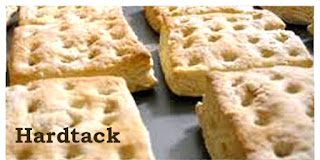
Hard as a rock, this cracker was the bane of many a Civil War soldier.  The ingredients were simple: wheat flour, water, and maybe some salt, mixed into a dense dough, rolled and cut into biscuit sized squares.  Mostly a food of the Yankee or Union Army, soldiers called the hard little biscuits, “tooth-dullers”.  Hardtack was almost inedible and nearly dense enough to stop a musket ball.  To soften, hardtack was often dunked in brine, coffee, or cooked with salt pork.  You can make hardtack, the recipe follows:

Ingredients:
2 cups of flour
 1/2 to 3/4 cup water 
6 pinches of salt
Optional:  add 1 tbsp of vegetable fat 

Preheat oven to 400 degrees F.  Mix the ingredients together into a stiff dough, knead several times, and spread the dough out flat to a thickness of 1/4 inch on a non-greased cookie sheet.  Using a knife, cut dough into 3-inch cracker squares.  Punch four rows of holes, four holes per row, into each cracker.

Bake for 30 minutes. Remove from oven, turn crackers over on the sheet and return to the oven and bake another 30 minutes. Cool completely.


Confederate Soldier
Sloosh

Many Southern soldiers simply cooked cornmeal mush around a rifle ramrod.  They took the cornmeal and swirled it around in grease, making a dough. They then wrapped the dough around their rifle ramrod and cooked it over the campfire. That was called "sloosh". 

Corn Pone
Corn pone was a staple of early settlers and Civil War soldiers.


Recipe

4 cups ground white or yellow cornmeal 
1 tablespoon salt 
2-3 cups of very hot (not boiling) water 
 1/4--1/2 cup bacon grease or other oil


In a large bowl, add the hot water to the corn meal and mix into a thick batter. Cover with a dishcloth and let it sit for 15 to 20 minutes. The batter should still be soft enough to mold into a small cake. 

Take your cast iron skillet and put it over a medium heat on the stove or over your fire, add the bacon grease or oil. When the oil is hot lay the cakes into the pan. Cook them until they are browned on one side, this should take about 3 minutes. Turn each and brown on the other side. Drain the fat and serve.


Food on the Home front 
Lacking many ingredients, the southern women learned to alter food recipes according to their scarce available resources.  


Oatmeal pie recipe:


The military needed a cheap way to feed a lot of people, and soldiers across the country were introduced to the idea they could eat their horses' oats.  So oats become a popular food.  During the Civil War  pecans were in short supply in the South, so oatmeal pie was a good substitute for southern pecan pie.


Idiot's Delight cake recipe:


An easy dessert to make, "Idiot's Delight" cake was quick and frugal.  It was often served on Christmas and Holidays.


Monday, November 14, 2016

Civil War: Black Confederate Soldiers, Real or Myth?


Nobody questions that the Confederate Army utilized blacks as cooks, teamsters, and body servants.  As for accepting slaves as soldiers, there had been resistance among Confederates to placing arms in the hands of slaves.  Fears of slave uprisings were factors.   Some assert the “black confederate” soldier is a myth.    

An iconic photograph has often been used as evidence of black confederate soldiers.  It is a 160-year-old tintype depicting Andrew Chandler and his slave Silas, both in Confederate uniform. 


Today, the descendants of Silas Chandler state firmly that Silas was Andrew Chandler's servant and slave. Silas Chandler was there when his master, Confederate Sgt. Andrew Chandler, was  wounded at the 1863 Battle of Chickamauga in Tennessee. Silas helped his injured master return home, saving Andrew’s leg from amputation.  But a Confederate soldier?  Perhaps not.

Yet in diaries we find references to the black Confederate soldiers:

"As usual with the enemy, they posted their negro regiments on their left and in front, where they were slain by hundreds, and upon retiring left their dead and wounded negroes uncared for, carrying off only the whites, which accounts for the fact that upon the first part of the battlefield nearly all the dead found were negroes." - Federal Official Records, Vol. XXV, Chapter XLVII, pg. 341 Report of the Confederate Commander, Savannah, April 27, 1864   

Although the Confederates did not officially enlist blacks until March 1865, when desperate for manpower, the Confederate Congress had passed a law allowing African Americans to serve in combat roles.  Some states allowed them to serve on a local level as early as 1861.  Perhaps no one knows how many blacks served as soldiers in the Confederacy.

Tuesday, October 11, 2016

Eyewitness to the Battle of Gettysburg - Tillie Pierce

Gettysburg, PA, 3-day battle, July 1 - July 3, 1863

Gettysburg was a small town in Pennsylvania, with rolling hills of corn and wheat fields and only 2,400 inhabitants.  The residents seemed unaware that two huge armies, about 170,000 men, were converging on their sleepy little town.  The fiercest battle of the war was about to ignite.  The Battle caught the residents of Gettysburg completely by surprise. 

Tillie Pierce:
Tilllie Pierce 16 years old at the time of the Battle.  Her father was a butcher and the family lived above his shop in the heart of town. She was attending the Young Ladies Seminary school when the cry is heard "the Rebels are coming!"

Soon Confederate soldiers were streaming through the area.

"Rushing to the door, and standing on the front portico we beheld a dark, dense mass, moving toward town.  Our teacher, Mrs. Eyster, at once said:  'Children, run home as quickly as you can.'  It did not require repeating. ...  I had scarcely reached the front door, when, on looking up the street, I saw some of the men on horseback.  

What a horrible sight!  There they were, human beings!  Clad almost in rags, covered with dust, riding wildly, pell-mell down the hill toward our home!  Shouting, yelling most unearthly, cursing, brandishing their revolvers, and firing right and left.

Soon ...ransacking began in earnest.  They wanted horses, clothing, anything and almost everything they could conveniently carry away.  Nor were they particular about asking. Whatever suited them they took.  They did, however, make a formal demand of the town authorities, for a large supply of flour, meat, groceries, shoes, hats, ... ten barrels of whisky; or, in lieu of this, five thousand dollars."

At the urging of her family, Tillie and some friends left the town and went to what they thought would be a safe place, Jacob Weikert's farmhouse.  

"During our flight over to the farm-house, and when about half way, Mrs. Weikert happened to think of some highly prized article of dress, that in our sudden flight she had never thought of. Nothing would do but that her husband would have to go back to the house and get it. Thus in the midst of the confusion of battle, Mr. Weikert started back. Just as we were reaching our starting point, we met him coming out with the treasure; a brand-new quilted petticoat; and we all went panting into the house. During the whole of this wild goose chase, the cannonading had become terrible! Occasionally a shell would come flying over Round Top and explode high in the air over head."

Sometime between 4 and 5 p.m. that afternoon, Tillie Pierce and her friends were caught between the opposing forces.

"On this evening the number of wounded brought to the place was indeed appalling. They were laid in different parts of the house. The orchard and space around the buildings were covered with the shattered and dying, and the barn became more and more crowded. The scene had become terrible beyond description."

Over 700 wounded and dying soldiers found shelter in the farmhouse and barn during the battle.  Tillie provided water and food to the soldiers and assisted the surgeons and nurses caring for the wounded.

The battle raged for 3 days.  "It seemed as though the heavens were sending forth peal upon peal of terrible thunder, directly over our heads; while at the same time, the very earth beneath our feet trembled. The cannonading at Gettysburg, has already gone down into history as terrible." 

After the battle:  "We were all glad that the storm had passed, and that victory was perched upon our banners.  But oh! the horror and desolation that remained. The general destruction, the suffering, the dead, the homes that nevermore would be cheered, the heart-broken widows, the innocent and helpless orphans! Only those who have seen these things, can ever realize what they mean."

"The whole landscape had been changed and I felt as though we were in a strange and blighted land."

Friday, October 7, 2016

Civil War Sweetener - Sorghum

Sorghum Arrives in America
The first sorghum arrived in North America on slave ships.  Sorghum is an ancient grain that was cultivated by the Egyptians.  In America it was used as livestock fodder and by enslaved people for food with its juice used to make syrup as a sweetener, an alternative to expensive sugar. 

Civil War
During the Civil War, the northern blockade of southern ports begun in 1861, caused many food shortages.  The Civil War scarcities led to replacement crops — chicory root for coffee, field pea mash for flour.  Among the scarce items was sugar.  Northerners  wanted to avoid supporting the sugarcane industry in the South and chose sorghum. Southerners turned to sorghum in place of cane sugar, because it was cheap and plentiful in the south.  

Sorghum is a grain that grows tall like corn.  From a distance it looks like corn. 

However, you’ll find no ears and there is a reddish tinge to the leaves, stalk and ripe seed head. Stalks stand up to 10 feet tall.

Sorghum holds a sweet juice extracted by crushing the cane. That sweet juice is then reduced until it runs slow as molasses, but boasts a deeper, more complex flavor. 


The Camel of Crops
Sorghum  is known as “the camel of crops” because it doesn’t need much water and grows in soils other grains won’t. It's a plant for tough times, and tough places.  

Much of the world is turning hotter and dryer these days, and it's opening new doors for sorghum.  Some farmers are looking for crops that aren't so "thirsty".  Aquifers are getting lower in areas, and crops such as corn need much more water than sorghum. Compared with corn, for instance, sorghum needs one-third less water, and it doesn't give up and wilt when rains don't come on time. It waits for moisture to arrive.

It flourishes in dry areas.  It’s an important crop in dry areas such as Ethiopia.  It is used to make a popular Ethiopian flatbread, injera, beverages, and feed farm animals.

Sorghum is Trendy
Sorghum has become a "trendy" food.  Sorghum is naturally gluten-free.  Some sorghums are high in antioxidants, which are believed to help lower the risk of cancer, diabetes, heart disease.  It is an ancient grain relatively untouched by modern agriculture.


Wednesday, December 4, 2013

Holiday Food Civil War - Idiot's Delight Cake


Food was scarce for the South, but they tried to celebrate Christmas and the Holidays.  Here is a frugal recipe used for party cakes in the South.

CIVIL WAR IDIOT'S DELIGHT CAKE

Idiot's Delight Cake
Ingredients

1 c. brown sugar
1 c. raisins
1 tbsp. butter
1 tsp. vanilla
4 c. water
7 tbsp. butter
1/2 c. white sugar
2 tsp. baking powder

1/2 c. milk
1 c. flour

Boil together the first 5 ingredients. Make a batter of the second 5 ingredients. Drop the batter in a greased pan by spoonfuls. Pour first mixture over it and bake in a moderate oven until golden brown.  Source:  Cooks.com
  

It was popular because it used only a few, inexpensive, easy to obtain ingredients and is fool-proof. Even an "idiot" can make it. 

Tuesday, November 19, 2013

Southern Women Outwit Yankee Soldiers

Hiding Valuables

As in any war, there was much theft and plunder by Yankee soldiers.  Southerners, however, had 2 advantages which helped ensure their survival:

1. Yankees did not recognize the patches of sweet potatoes, thinking they were weeds, and overlooked them.

2. Southerners knew their local terrain.  They knew its hiding places, and hid livestock such as pigs, and valuables in swamps and forests.

Diary of Nancy Emerson  
Staunton, VA  July 13, 1864
"They told us that Crook's men were a great deal worse than they, & that was true, but they were bad enough & worse at some other places than with us.  At one of our neighbors, they took every thing they had to eat, all the pillow cases & sheets but what were on the beds, & the towels & some of the ladies stockings.  One of them made up a bundle of ladies clothing to take, but his comrade shamed him out of it.                 

They then poured out their molasses, scattered their preserves & sugar & other things about the floor, & mixed them all together & destroyed things generally."


Diary of Estelle Laughlin 
"Word was sent by a neighbor's young houseboy ... that the Union soldiers were foraging, and so they had a little time to hide things.

All the keepsakes that they felt the Union soldiers might take were hastily dumped into a large, dark-colored bag.  Uncle Adam suspended it down into the well by the long rope.

The Union soldiers arrived and took the chickens, and some other things, but when they went through the house, they couldn't seem to find anything of value.

When the soldiers stopped at the well to draw up a bucket of cold water, the hearts of the watching family were in their throats, but by good fortune they didn't notice the rope suspended into the well, or else thought it was merely something put down in the well to be kept cold, as was the custom, and so the family treasures were saved."

Click below to read more:


Wednesday, November 13, 2013

Frugal Civil War Cooking: Oatmeal Pie recipe

There were many food shortages caused by Civil War blockades.  The following recipe provides flavors that substitute for pecans, which were hard to find.  A very frugal recipe and tasty.


Old Fashioned Oatmeal Pie

Ingredients:

1 (9 inch) pie crust
4 eggs

1 cup sugar
2 tablespoons flour
1 teaspoon ground cinnamon
1/4 teaspoon salt
1 cup light corn syrup (sorghum or molasses during Civil War)
1/8 to 1/4 cup melted butter
1 teaspoon vanilla
1 cup quick cooking oatmeal (uncooked)

Directions:
Preheat oven 350 degrees. Beat eggs until frothy. Combine sugar, flour, cinnamon, and salt in small bowl. Add eggs and mix well. Add corn syrup, melted butter and vanilla. Mix oatmeal. Pour into uncooked pie shell. Bake for 45 minutes. 


Oatmeal pie is also known as “poor man’s pecan pie” or “mock pecan pie.”  Another time in U.S. history when oatmeal pie was popular was during the Great Depression when everything was in short supply. Oatmeal pie is made with basic ingredients that were and still are in most of our pantries. 

Click below to read more: